
Tracking Research
Tracking research continues to be an important tool in a marketing researcher’s toolbox. It can provide valuable insights into market trends and shifts to help set both strategic and tactical direction.
What is tracking research?
Tracking research is ongoing, repeated research that measures key metrics at regular intervals to monitor for changes. It focuses on trends over time, not just a snapshot in time, and is often used as a measure of progress.
What can tracking research monitor?
The focus of tracking research can be a brand, an advertisement, a set of competitors, a category, etc. It can measure a variety of topics where understanding change over time is important. Typical topics include:
- Brand behavior: awareness, consideration, usage.
- Brand equity: brand associations, relevance, sentiment.
- Marketing effectiveness: marketing awareness/recall, campaign diagnostics.
- Customer experience: satisfaction, NPS/advocacy, service performance.
- Competitive and category dynamics: competitor awareness/consideration/usage, relative perceptions, category drivers, substitution.
- Emerging trends and unmet needs: new occasions, pain points, evolving decision criteria.
How frequently should tracking research be conducted?
There is no hard and fast rule for how often to conduct tracking research. The key is to match the frequency to the expected rate of change. More volatility requires more frequent measurement, while slower movement requires less frequent measurement. Timing can range from continuous to periodic.
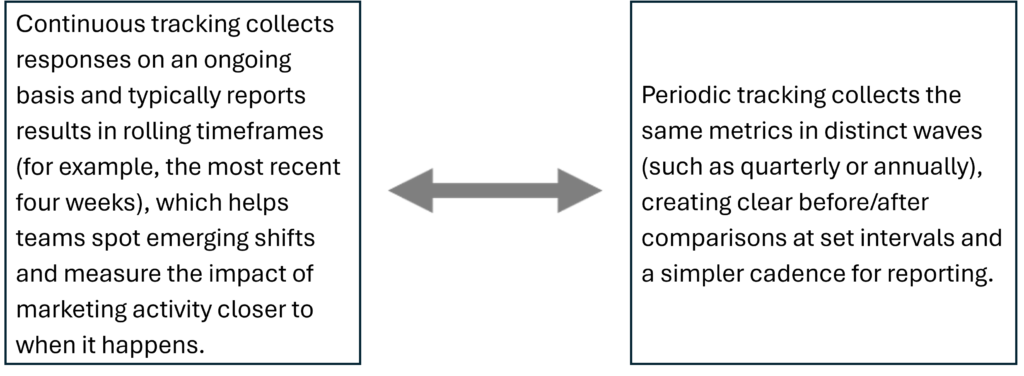
Timing can also be associated with a specific event, such as an advertising campaign. With an event, tracking research is often conducted in a pre-post fashion. This means getting a measurement before the event and then a second measurement after the event.
What are the benefits of tracking research?
- Acts as an early warning system by identifying shifts in awareness, sentiment, or usage before they impact sales.
- Measures the impact of events such as campaigns, PR, pricing changes, launches, and competitive moves over time.
- Helps distinguish real changes from one-off blips through trend analysis.
- Informs decision-making by identifying where to invest resources based on market movements.
- Establishes benchmarks and KPIs for key metrics, supporting organizational targets, and performance thresholds.
- Enables segmentation tracking by monitoring how audiences differ and how their responses change over time.
- Builds organizational alignment through a shared, repeatable scorecard that facilitates stakeholder consensus.
- Provides context for “why” by linking links metric movement to underlying reasons.
What to keep in mind when designing tracking research?
Tracking research relies on recurring measures to monitor changes over time. The initial design is critical—need to establish a core set of questions that will be monitored. It is important not just to measure changes, but also to understand the why behind the changes.
Consistency is critical because the goal is to measure real change over time. Changing question wording, scales, or response options can create a break in the trend, making it unclear whether scores moved because the market changed or because the measurement changed. That said, questions sometimes need updating when the category evolves, the business priorities shift, or the existing question is no longer valid or necessary.
It is important to leave room in the survey for ad hoc, custom questions as new topics arise or there is a need to clarify existing findings. Also, be mindful that analysis can become stale if you repeat the exact same questions every time; balance consistency with the need for fresh insights.
Summary
Tracking research serves as a powerful tool for organizations to monitor key metrics and identify trends over time. By consistently measuring areas such as brand behavior, equity, marketing effectiveness, customer experience, and emerging trends, organizations can make informed decisions and adapt strategies to stay competitive. The ongoing nature ensures that shifts in consumer perceptions and market dynamics are captured, supporting continuous improvement and long-term success.
Reach out to the Persuadable Research team to discuss how we can assist you with your tracking research needs.